

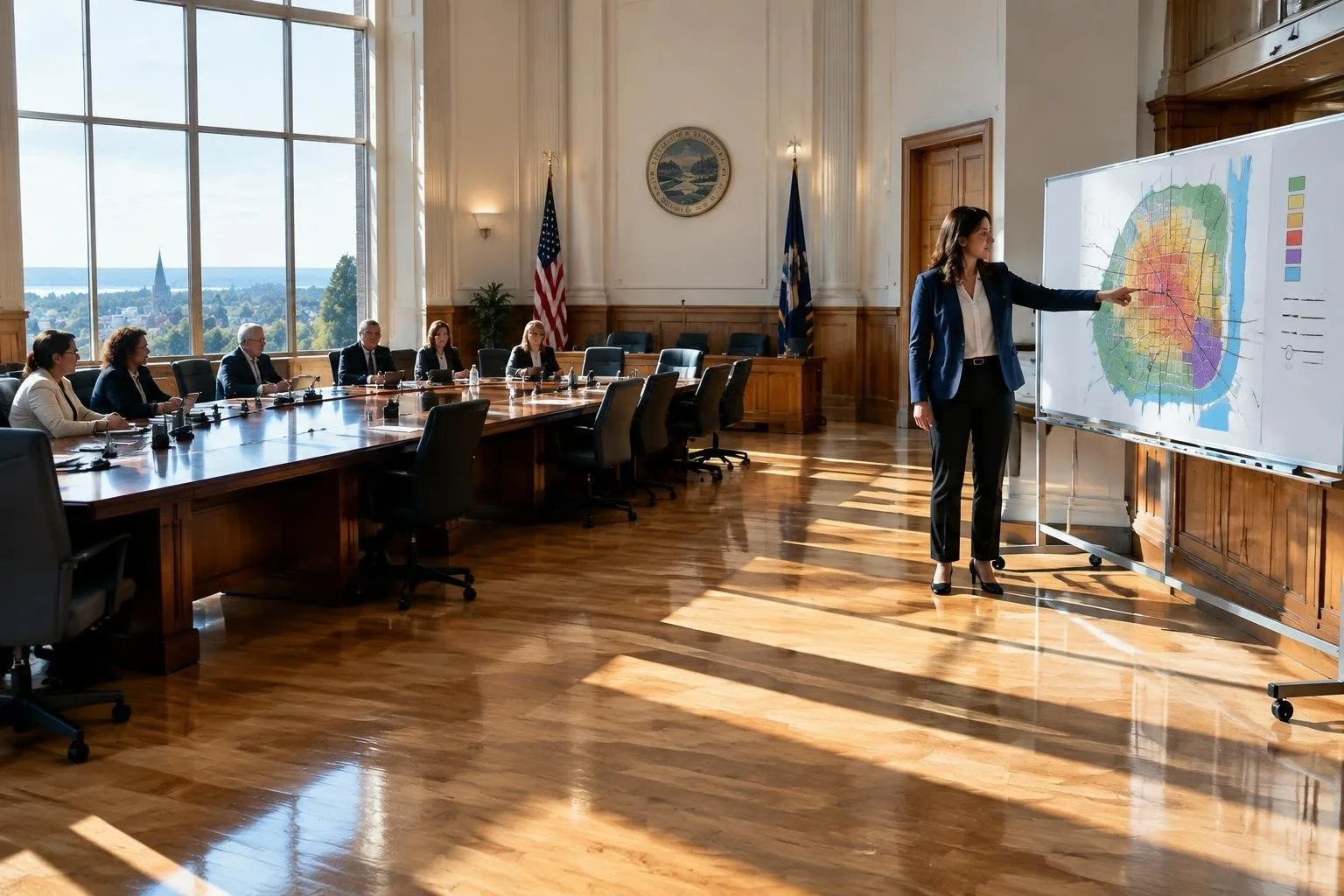
The comprehensive plan is an outline for future land use, infrastructure and growth that guides a community’s development over many years. The City of St. Marks, located in Wakulla County, Florida, has launched a statutory review of this document to align it with recent state requirements and local conditions.
Statutory requirement and timeline
Florida Statutes § 163.3191 obliges every municipality to evaluate its comprehensive plan at least every seven years. St. Marks has not completed such a review for several cycles, prompting officials to label the current effort a “compliance update.” William Garner, the city attorney, explained, “And it’s been a number of years since the City of St. Marks has done that, and there are several things that need to be added in addition to the time horizon that these plans are good for. And so what we’re doing is a compliance update to bring the comprehensive plan into compliance with state law.”
The statutory process also requires that any amendment be presented to the public before adoption. Accordingly, the city scheduled a second public hearing for December 10, giving residents another chance to comment before the revised plan is formally adopted.
ARPC technical review and priority recommendations
The Apalachee Regional Planning Council (ARPC) examined the existing document and identified several gaps. Although the community is not projected to grow rapidly—census data show a 2025 population of roughly 335 residents with an estimated rise to 400 by 2050, an increase of only 65 people—the council highlighted aging water and wastewater systems, limited storm-water capacity, and a pronounced vulnerability to coastal flooding. Caroline Smith, Deputy Director of Operations and Economic Development for ARPC, noted, “It happens, it happens more often than people think, and that simply means that we need to do a statutory update to bring it back into compliance.”
Based on these findings, ARPC recommends directing future development toward already serviced neighborhoods, preserving existing land-use patterns, and prioritizing upgrades that bolster flood and coastal resilience. Rather than pursuing large-scale capacity expansion, the council suggests targeted capital improvements—such as rehabilitating aging bridges, reinforcing shoreline defenses, and enhancing drainage—to protect the modest population growth anticipated over the next three decades.
Community feedback and upcoming hearing
The public workshop revealed practical concerns from local residents. Parking emerged as a recurring theme, with participants pointing out the scarcity of city-owned land for new projects and the need to accommodate visitors to amenities like the boat ramp and marina. Garner remarked, “We don’t have a lot of city property where we can just develop it, so it’s always a consideration and things that we have to think about how we’re going to provide adequate parking, whether it be with new development or just for people to use the amenities that come from outside the city.”
Feedback collected during the workshop and through an online survey will be incorporated into the draft plan. ARPC confirmed that the agency will weave community suggestions into the final document, aiming for a revision that meets statutory standards while reflecting local priorities. “Our next step is to take the input we received during the public workshop, as well as from the survey, and from commissioner comments, and incorporate all of those comments into the draft comprehensive plan,” Smith said. Residents who could not attend are encouraged to submit comments via the city’s survey link before the December 10 hearing.